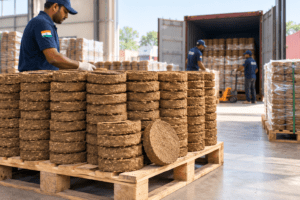
India has quietly become one of the world’s most consistent sources of cow dung cake, a product most first-time importers underestimate until they see the order volumes. What used to be a purely rural, domestic-use item — burned for cooking fuel or used in religious rituals — is now moving through formal export channels into fertilizer markets, biomass energy buyers, incense manufacturers, and eco-construction companies across the Middle East, Southeast Asia, Europe, and North America.
If you’re asking how to export cow dung cake from India, the honest answer is that the product itself isn’t the hard part. The hard part is building a supply chain that can deliver consistent moisture content, uniform weight, and clean documentation, order after order. This guide walks through exactly what that requires.
Why Global Demand for Indian Cow Dung Cake Is Rising
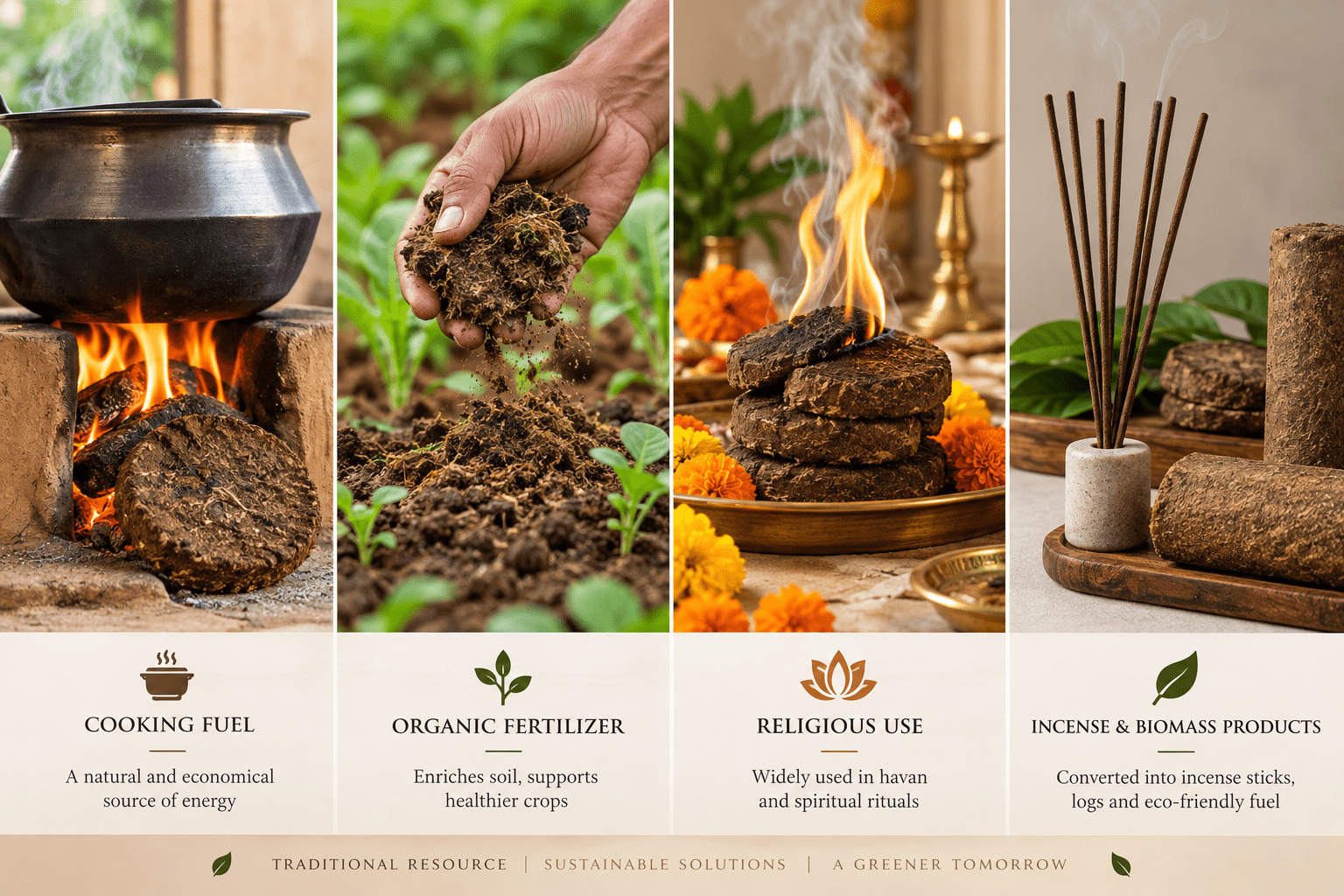
Three separate buyer categories are driving demand, and they rarely overlap:
Organic farming and fertilizer buyers want cow dung cake as a slow-release, chemical-free soil amendment. As synthetic fertilizer costs rise and more countries push organic certification standards, dried manure products from India — where cattle populations and traditional drying methods are well established — have become a reliable input.
Religious and cultural-use buyers, primarily in Nepal, the Gulf countries, the UK, and the US, import cow dung cake for Hindu ritual use (havan, puja) and for cremation-related religious practices among diaspora communities. This is a stable, low-volatility demand segment.
Biomass fuel and incense manufacturers use processed cow dung — often dried, powdered, or logged — as an input for eco-friendly fuel logs, mosquito repellent coils, and incense sticks. This segment is growing fastest because it sits inside the broader renewable-biomass and eco-product trend.
What Exactly Is Being Exported: Product Forms
Buyers don’t all want the same physical product, and specifying this correctly avoids wasted negotiation:
- Sun-dried whole cakes — the traditional round or flat patty, hand-shaped or mold-pressed, typically 100g–500g per piece
- Machine-pressed blocks — uniform size and density, easier to palletize and ship in bulk containers
- Dung powder — ground and sieved, used mainly as a fertilizer or incense input
- Dung logs/sticks — cylindrical, longer-burning, used for havan and biomass fuel applications
Buyers sourcing for fertilizer or fuel use typically order by weight (per kg or per metric ton); buyers sourcing for religious use often order by piece count and want a specific diameter and finish.
HS Code and Export Documentation
Cow dung cake is classified under HS Code 3101 (Animal or vegetable fertilizers), with Indian exporters commonly filing under the 8-digit sub-heading 31010090 or 31010091 depending on processing form. Because sub-classification can shift based on whether the product is raw, processed, or blended with other organic matter, always confirm the exact code with your Customs House Agent (CHA) before filing a shipping bill — this is not a code to guess on.
To export legally from India, you need:
- Import Export Code (IEC) — issued by DGFT, mandatory for any exporter
- GST registration — required for invoicing and tax compliance
- Shipping bill filed under the correct HS code
- Certificate of Origin — often requested by importing countries
- Phytosanitary or fumigation certificate — some destination countries require this for organic/animal-derived products, so check the importing country’s biosecurity rules before shipment
- Packing list and commercial invoice matching the buyer’s purchase order exactly
Cow dung cake generally falls outside India’s restricted/prohibited export list, but rules can vary by destination country’s import regulations — particularly countries with strict biosecurity controls on animal-derived organic material. Always verify the buyer country’s import permit requirements before confirming an order.
Quality Standards Buyers Actually Check
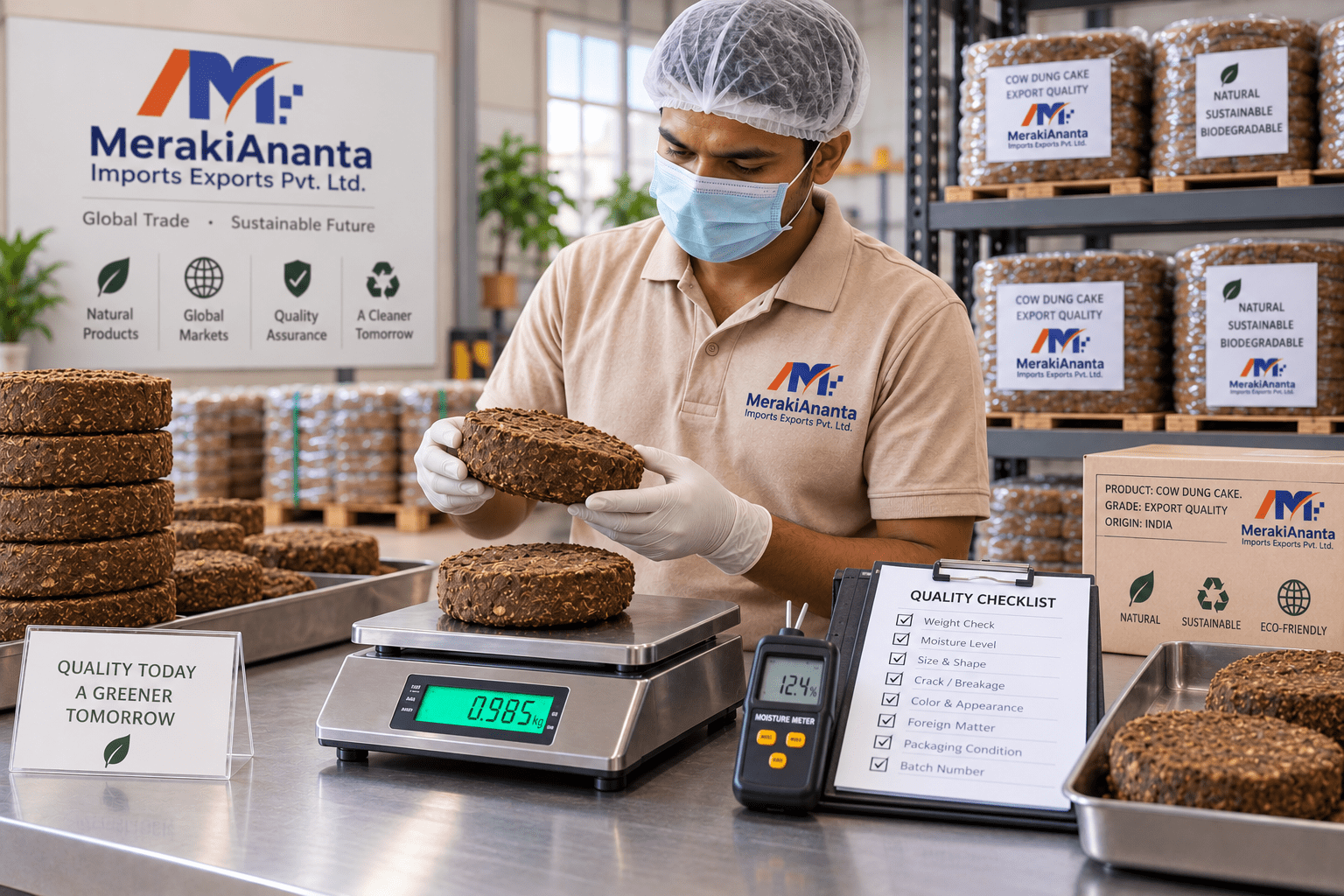
Serious international buyers reject shipments over a small set of recurring issues:
- Moisture content — most buyers want below 12–15%; higher moisture leads to mold during long sea transit
- Consistent weight and size — critical for buyers doing per-piece religious-use orders
- Odor control — properly sun-dried and aged cakes should have minimal odor; fresh or improperly dried product fails this immediately
- Packaging integrity — cakes crumble easily if not packed with adequate cushioning; breakage during transit is one of the top complaint categories for this product
Packaging and Shipping for Export
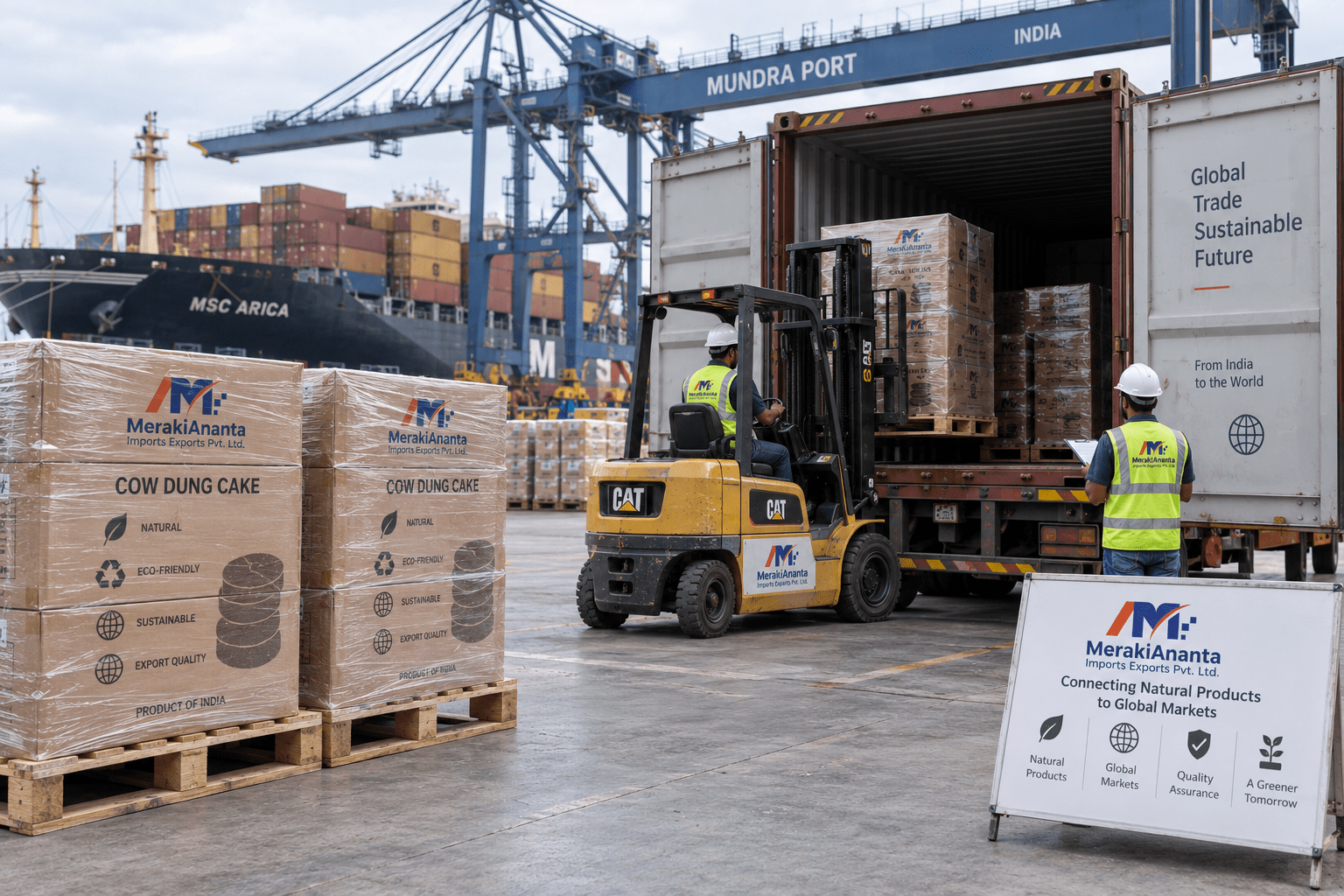
Standard export packaging includes biodegradable eco-bags or jute sacks for smaller retail-style orders, and stacked, shrink-wrapped pallets or bulk poly-lined cartons for container loads. Shipments typically move via sea freight in standard 20ft or 40ft containers for bulk fertilizer/fuel orders, with air freight reserved for smaller, high-value religious-use orders where speed matters more than cost per kg.
Minimum order quantities in the market range widely — from 500 kg to full container loads of 10–20 metric tons — depending on whether the buyer is a small distributor or a bulk fertilizer/biomass processor.
Common Export Challenges — and How to Avoid Them
- Inconsistent supplier quality — the biggest failure point; work with aggregators who standardize drying and grading rather than single small farms
- Underestimating documentation timelines — phytosanitary certification and country-specific import permits can add 1–3 weeks; build this into your quote lead time
- Packaging failure in transit — invest in proper cushioning and moisture-barrier packaging rather than cutting cost here
- Buyer misclassification of use case — always confirm whether the buyer wants fertilizer-grade, fuel-grade, or religious-use grade before quoting, since specs differ meaningfully
How MerakiAnanta Imports Exports Handles Cow Dung Cake Export
MerakiAnanta Imports Exports Pvt. Ltd. exports cow dung cake as part of its agri-based export portfolio, alongside fruits, vegetables, spices, pulses, and eco-friendly products. The operating approach is built around the same discipline applied to every product line: supplier coordination and grading before an order is quoted, documentation and compliance handled end-to-end (IEC, GST, shipping bill classification, certificates of origin, and destination-country import requirements), consistent moisture and weight specifications across every shipment, and export-grade packaging designed to survive full sea-freight transit without breakage.
MerakiAnanta does not operate as a broker reselling whatever stock is available. Orders are sourced, quality-checked, and shipped against the specification the buyer actually needs — fertilizer-grade, fuel-grade, or religious-use grade — rather than a generic batch.
If you’re a bulk buyer, distributor, or importer looking to source cow dung cake from India — for fertilizer, biomass fuel, incense manufacturing, or religious use — MerakiAnanta can deliver to your specification and destination port. Reach out with your required grade, order volume, and destination country, and we’ll quote a shipment plan.

Frequently Asked Questions
- Is cow dung cake legal to export from India?
Yes. It is not on India’s restricted or prohibited export list, though importing countries may apply their own biosecurity or phytosanitary requirements that need to be checked before shipment. - What is the minimum order quantity for exporting cow dung cake?
This varies by supplier and buyer type — anywhere from 500 kg for smaller religious-use orders to full container loads of 10–20 metric tons for fertilizer or fuel buyers. - Which countries import the most cow dung cake from India?
Nepal, UAE, Saudi Arabia, and other Gulf countries for religious use; parts of Southeast Asia and Europe for organic fertilizer and biomass fuel applications; the US and UK primarily for diaspora religious-use demand. - What packaging is required for export?
Biodegradable eco-bags or jute sacks for retail-style orders; shrink-wrapped or poly-lined bulk pallets for container shipments, with moisture-barrier packaging strongly recommended for sea freight.
Final Word
Cow dung cake is a real, exportable commodity with steady global demand — but it rewards operators who treat it with the same rigor as any other agri-export product: consistent grading, proper documentation, and packaging built for the transit it will actually face. That discipline, more than the product itself, is what determines whether a shipment clears smoothly or gets rejected at the port.